Software and Online ToolsKKT-HardNetAshfaq Iftakher, Rahul Golder, Bimol Nath Roy, Faruque Hasan KKT-HardNet is a next-generation hybrid modeling framework that bridges the gap between physics-based modeling and machine learning (ML). Building on the foundation of Physics-Informed Neural Networks (PINNs), KKT-HardNet introduces a novel architecture that strictly enforces physical laws, linear and nonlinear equations as well as inequality constraints. Unlike conventional PINNs or data-driven models that incorporate physical laws as soft penalties, KKT-HardNet embeds domain knowledge as hard constraints directly within the neural network structure.
KKT-HardNet is now officially available as a Python package. We have upgraded the framework with CUDA support and a more modular problem construction pipeline, making it faster and easier to use than before. Package: download here Code: download here 𝑲𝒆𝒚 𝒊𝒎𝒑𝒓𝒐𝒗𝒆𝒎𝒆𝒏𝒕𝒔: 📈 𝘐𝘮𝘱𝘳𝘰𝘷𝘦𝘥 𝘱𝘳𝘦𝘥𝘪𝘤𝘵𝘪𝘰𝘯 𝘢𝘤𝘤𝘶𝘳𝘢𝘤𝘺 𝘢𝘯𝘥 𝘪𝘯𝘧𝘦𝘳𝘦𝘯𝘤𝘦 𝘵𝘪𝘮𝘦 ⏱️ 𝘍𝘢𝘴𝘵𝘦𝘳 𝘢𝘯𝘥 𝘮𝘰𝘳𝘦 𝘦𝘧𝘧𝘪𝘤𝘪𝘦𝘯𝘵 𝘵𝘳𝘢𝘪𝘯𝘪𝘯𝘨 𝘰𝘯 𝘣𝘰𝘵𝘩 𝘊𝘗𝘜 𝘢𝘯𝘥 𝘎𝘗𝘜 🧩 𝘔𝘰𝘥𝘶𝘭𝘢𝘳 𝘥𝘦𝘴𝘪𝘨𝘯 𝘧𝘰𝘳 𝘧𝘭𝘦𝘹𝘪𝘣𝘭𝘦 𝘱𝘳𝘰𝘣𝘭𝘦𝘮 𝘴𝘦𝘵𝘶𝘱 Contact Dr. Faruque Hasan (Email) for more on KKT-HardNet and use. 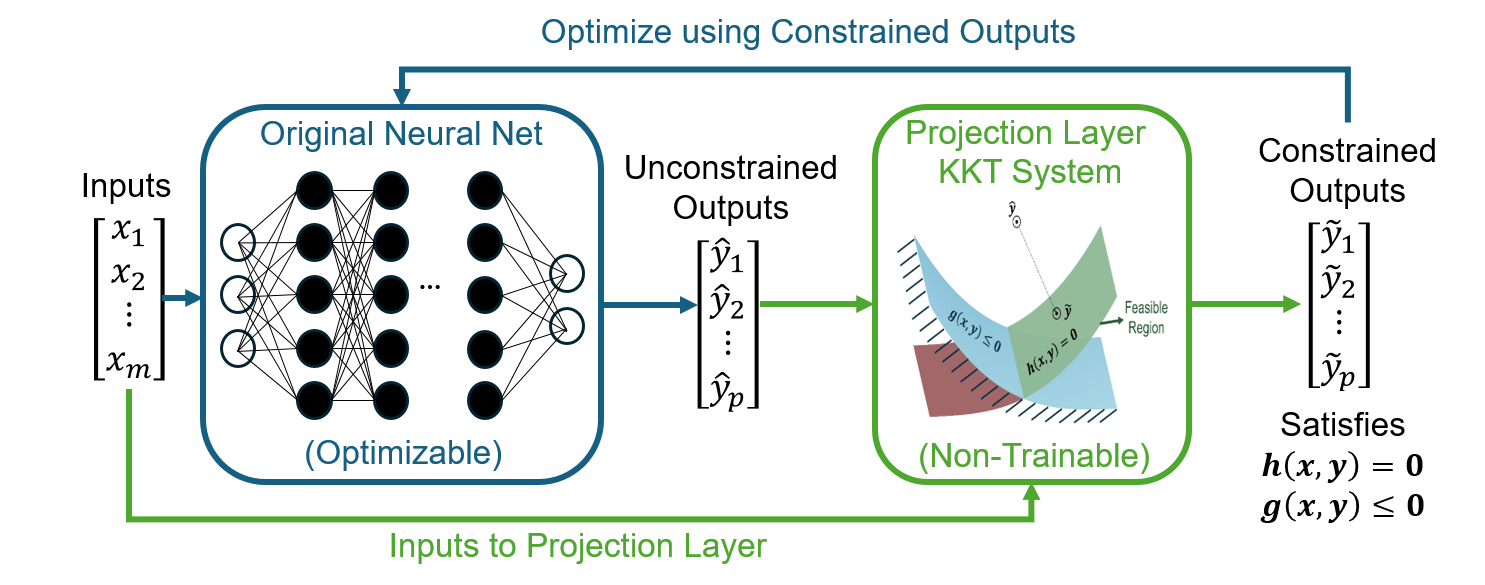 Reference:
SPICE_MARSM. Sadaf Monjur, Faruque Hasan SPICE_MARS stands for Synthesis and Process Intensification of Chemical Enterprises involving Membrane-Assisted Reactive Separations. It is a software prototype for the conceptual design, simulation, synthesis and optimization of membrane reactor based processes. At the conceptual design stage, it can be used to determine whether MR-based process intensification is favorable or not. If MR is favorable then, it can automatically decide on species to be separated and type of suitable respective membranes. The framework can also be used to perform rigorous simulation of MR to compute sensitivity analysis, techno-economic analysis (TEA), and life cycle assessment (LCA). At the synthesis level, SPICE_MARS can select appropriate MR configurations in terms of counter-current, co-current or cross-current flows in the permeate and retentate sides; reactor lengths; membrane areas; and catalyst amounts. Finally, it can be used for property-performance mapping to map the most desired properties of novel membranes for intensification purposes. Contact Dr. Faruque Hasan (Email) for more on SPICE_MARS and use.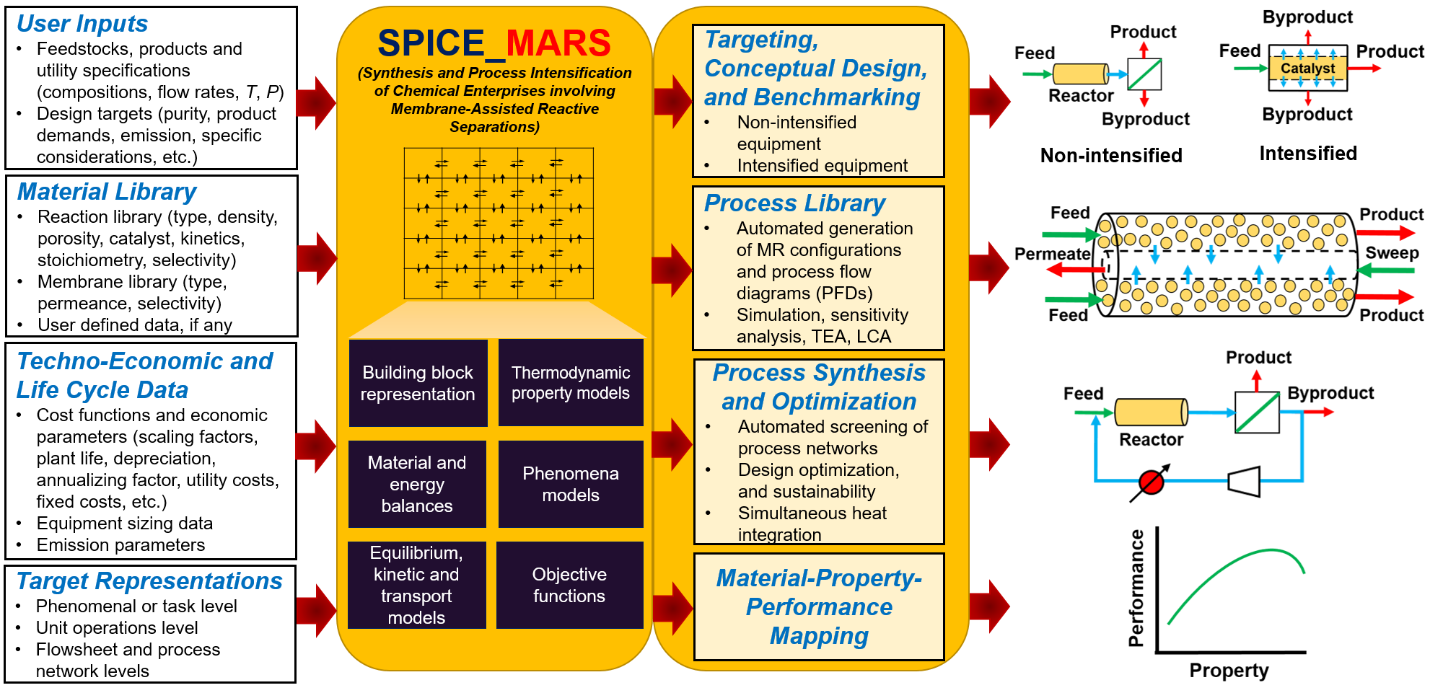 Reference:
SPICEHasan, Li, Demirel SPICE Home PageSPICE is a process intensification (PI) toolbox. SPICE stands for Systematic Process Intensification of Chemical Enterprises. SPICE automates the generation and optimization of process flowsheets including intensified alternatives without postulating their existence a priori. This generates intensified process flowsheets with improved performance, allows innovation in process design, and brings technical innovation with operational excellence, sustainability and energy efficiency. 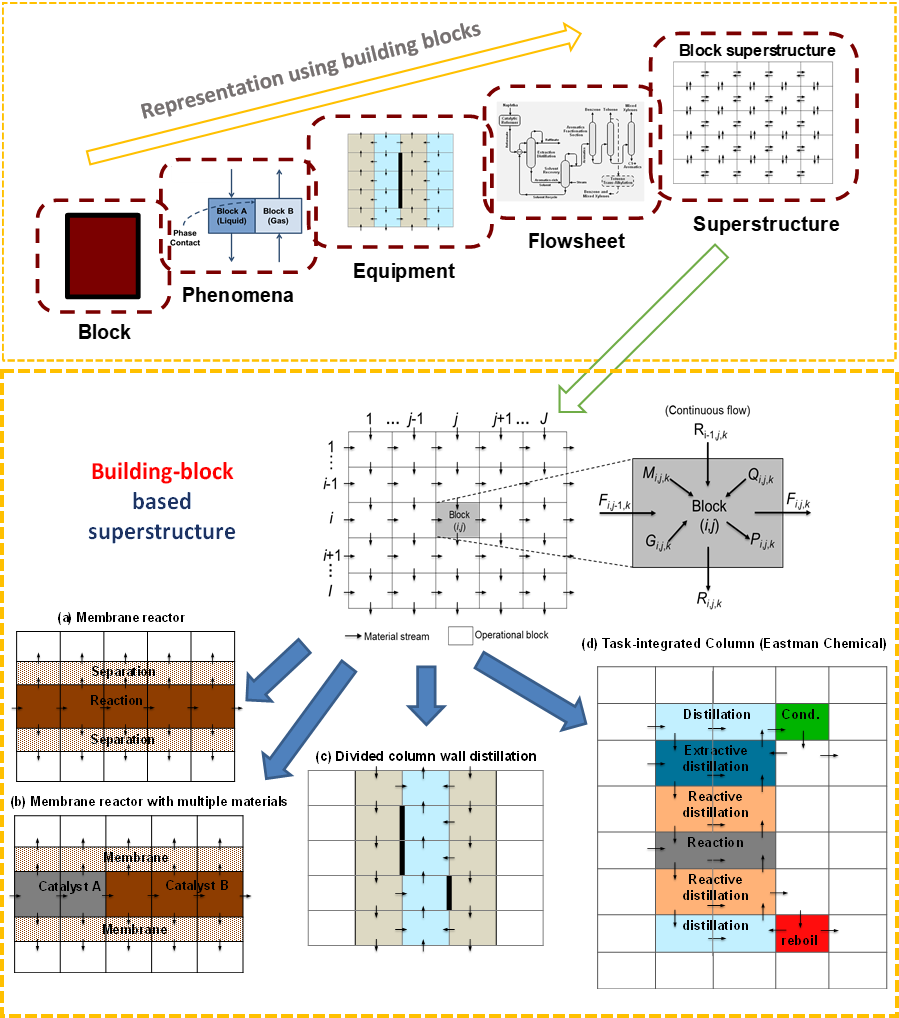
THESEUSHasan, Gandhi, Zantye THESEUS Home PageTHESEUS stands for TecHno-Economic framework for Systematic Energy Storage Utilization and downSelection which is a framework designed to identify cost efficient energy storage technologies for (i) power plant model parameters, (ii) a given demand profile and (iii) region-specific parameters such as cost of electricity, carbon tax, etc. The software prototype for THESEUS can generate optimal design and scheduling solutions for energy storage systems with flexible carbon capture. Individual storage technologies are developed in detail and surrogate models with high accuracy are used in the framework. Overall, 9 storage technologies along with flexible carbon capture are integrated for the downselection problem. The optimization model provides solution of sizing of individual technologies for power and storage capacity to minimize cost along with optimal charging and discharging schedule for each technology. The flexibility of the general formulation is demonstrated by its capability to handle multiple storage technologies along with flexible carbon capture. The software prototype can be used for obtaining the design and scheduling solution with a minimized levelized cost of storage (LCOS) and the absorption and desorption schedule for the carbon capture plant. 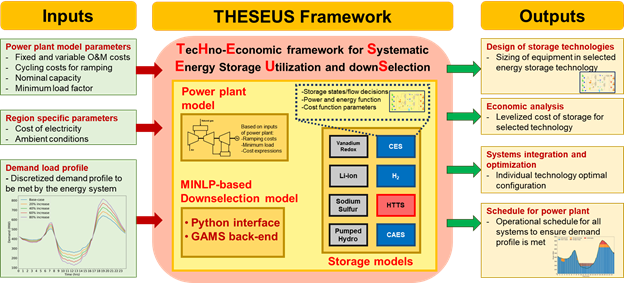

UNIPOPTBajaj, Hasan UNIPOPT Home PageUNIPOPT is a derivative-free optimization (DFO) algorithm that solves complex optimization problems using input-output data or samples. Many important problems in engineering, biology, materials science, physics and chemistry fall in the category of DFO. While there exists several excellent DFO solvers, many suffer from three key challenges: (1) curse of dimensionality, (2) unknown solution quality due to black-box objective function, and (3) unknown feasible region due to black-box constraints. DFO methods require large number of samples to solve high-dimensional problems. Often they fail to locate any solution (local or global) when the dimension is ten or more. UNIPOPT (UNIvariate Projection-based OPTimization) is based on projecting all the samples onto an auxiliary univariate space. We have tested this method over many test problems from several libraries. GRAMSArora, Iyer, Hasan GRAMS Home PageGRAMS (Generalized Reaction-Adsorption Modeling and Simulation) platform captures both reaction and adsorption dynamics in columns with solid catalysts, porous adsorbents or both. It is based on a one-dimensional, pseudo-homogeneous, non-isothermal, non-adiabatic and non-isobaric model that is extensively validated using experimental data from literature for different adsorption-reaction systems. Using GRAMS, both simulation and optimization can be performed for a wide range of configurations of a packed columns containing pure catalyst as in a fixed bed reactor, pure adsorbent as in a multi-step pressure swing adsorption (PSA) process, homogeneously-distributed uniform mixture of adsorbent and catalyst as in a cyclic sorption enhanced reaction process (SERP), or heterogeneously-compartmentalized adsorbent and catalyst as in a layered SERP. 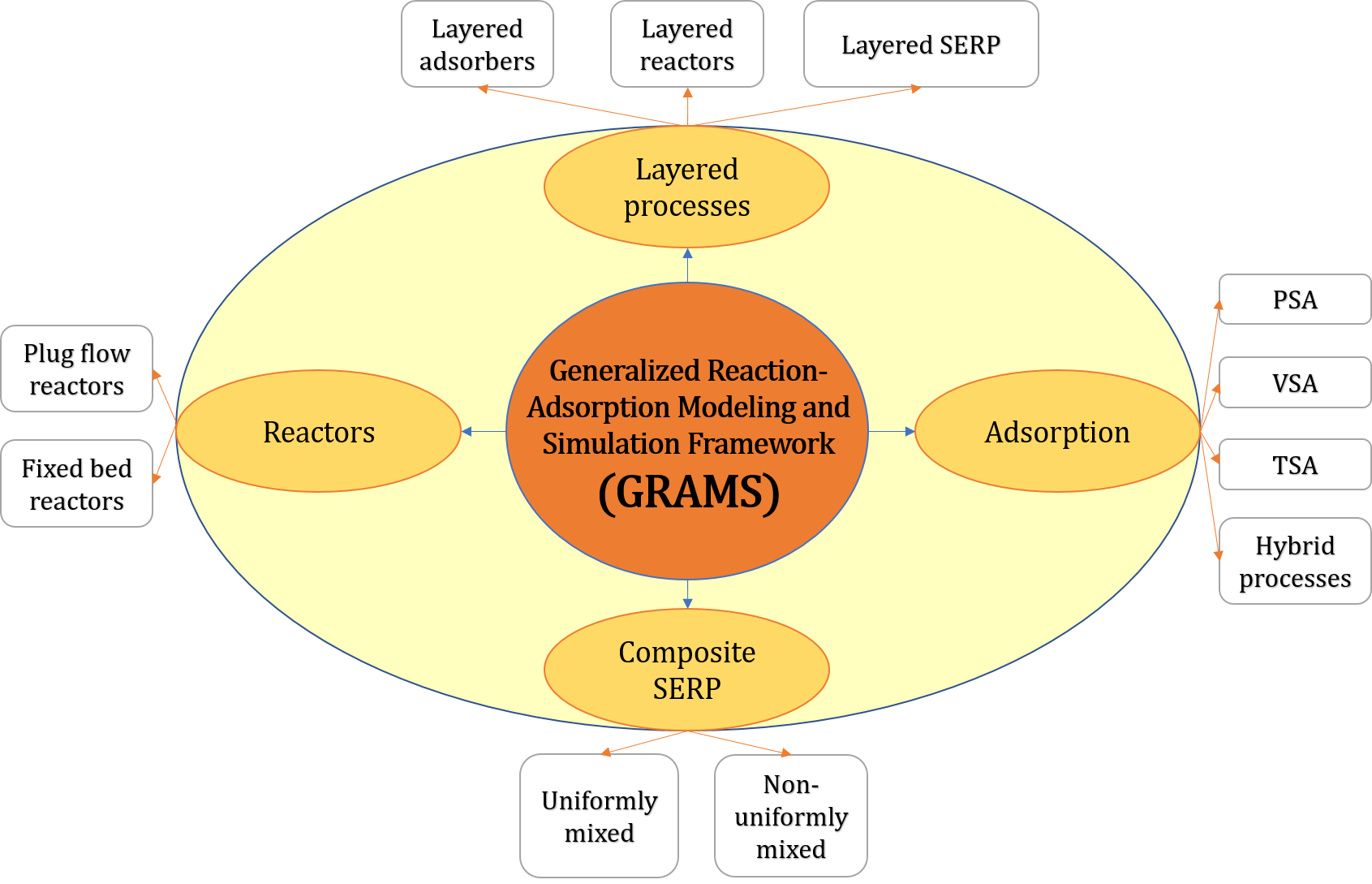
|